Section 1.5: Nucleotides
STUDY
Question 1:
Nucleotides involve in the cell's use of _____ and comprising the building blocks of every organism's _____. They're composed of 3 components: _____, _____, and _____.
→ Energy
Genetic material
A 5-carbon (pentose) sugar
A nitrogenous base
A phosphate group
**Review**

(Source: http://image.slidesharecdn.com/organicchemistry-131105135539-phpapp02/95/organic-chemistry-7-638.jpg?cb=1383659789)
Question 2:
In DNA, the highly stable _____, along with the _____, are able to link together to form a stable and organized backbone.
→ Sugars
Phosphate groups
Question 3:
Both sugars and phosphate groups are _____ (polar or non-polar) and, thus, can face _____ (outward or inward) into the watery solvent of the cell.
→ Polar
Outward
Question 4:
Nitrogenous bases can form _____ (weak, moderate, or strong) _____ bonds with each other that stabilize the _____-stranded (single or double) structure of DNA but can also be separated to allow the replication of genetic material.
→ Weak
Hydrogen
Double
Question 5:
Nucleoside = _____ sugar + _____ base + _____ (number) phosphate groups
Nucleotide = _____ sugar + _____ base + _____ (number) phosphate groups
→ Pentose
Nitrogenous
0
Pentose
Nitrogenous
1 or more
Question 6:
Nucleotides are _____ (monomers or polymers), whereas nucleic acids are _____ (monomers or polymers). _____ (nucleotides or nucleic acids) form polymers to create _____ (nucleotides or nucleic acids).
→ Monomers
Polymers
Nucleotides
Nucleic acids
Question 7:
Nucleotides form polymers to create nucleic acids, _____ and _____, which allow for expression of genetic traits by specifying the production of _____ (carbohydrates, proteins, or lipids).
→ DNA (DeoxyriboNucleic Acid)
RNA (RiboNucleic Acid)
Proteins
Question 8:
In nucleic acids, nucleotides are joined together into long strands by _____ bonds between phosphate group of 1 nucleotide and 3rd carbon of pentose sugar of the other nucleotide, forming a _____ backbone.
→ Phosphodiester
Sugar-phosphate
Question 9:
Nucleotides are written in the _____ (5' to 3' or 3' to 5') direction, so that the top strand runs _____ (5' to 3' or 3' to 5') and the bottom strand runs _____ (5' to 3' or 3' to 5').
→ 5' to 3'
5' to 3'
3' to 5'
Question 10:
Name 4 nitrogenous bases and their abbreviation in DNA. Identify which 2 are purines and which 2 are pyrimidines. Identify complementary strands and how many H-bonds are formed between them, with " = " means 2 H-bonds and " ≡ " means 3 H-bonds.
→ Adenine (A) = Thymine (T)
Guanine (G) ≡ Cytosine (C)
**Mnemonic**
Pyrimidine: cytosine and thymine
Question 11:
Purine is a _____-ringed (number) structure, whereas pyrimidine is a _____-ringed (number) structure.
→ 2
1
Question 12:
DNA usually exists in double-stranded structure described by the _____ model, named after 2 scientists who are credited with 1st theorizing DNA structure.
→ Watson-Crick
**Self-notes**
Special thanks to Rosalind Franklin, an unsung hero
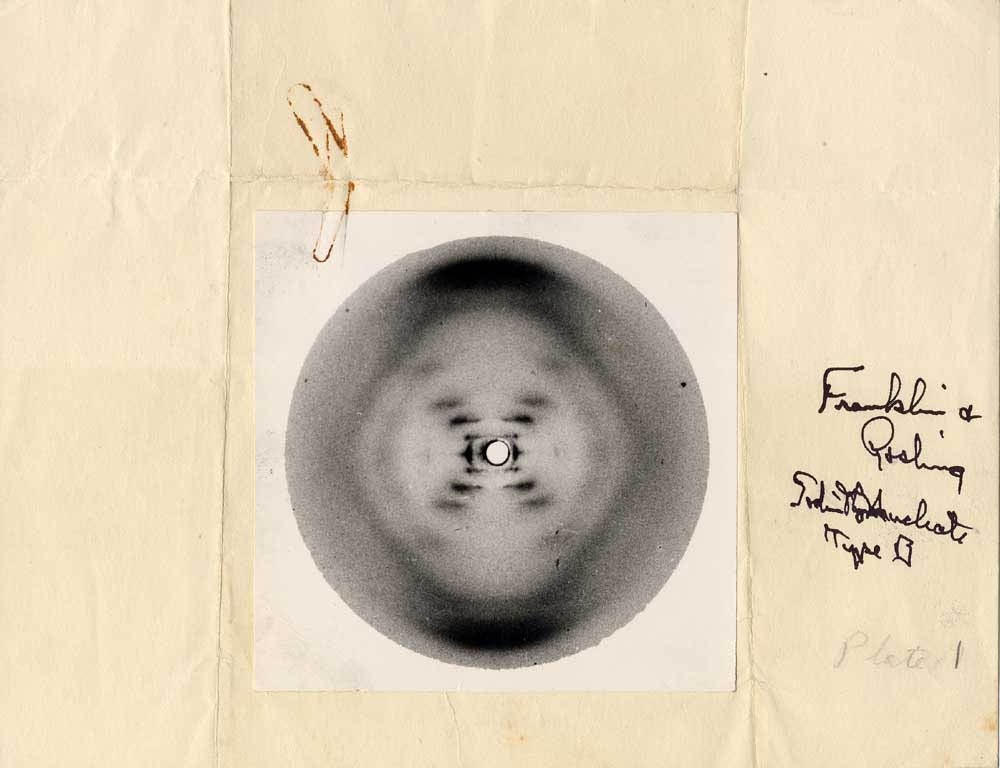
(Source: https://askabiologist.asu.edu/sites/default/files/resources/articles/crystal_clear/Rosalind_Franklin_Plate_1_DNA_B_form_1000.jpg)
In double-stranded structure, AKA the B form, the 2 strands run side-by-side in opposite _____ (5' to 3' or 3' to 5') direction (thus, anti-parallel) bound together by _____ bonds between nitrogenous bases. This bonding is often referred to as _____. The length of DNA strands is measured in _____.
→ 3' to 5'
Hydrogen
Base-pairing
Base-pair (bp)
Question 14:
2 strands that match up in the correct order with each other are called _____ strands. When they bind together, they curl into a _____ which contains 2 distinct grooves called the _____ and the _____. Each groove spirals _____ (once or twice) around the structure for every _____ (number) base-pairs. This DNA structure is _____ (stable or unstable) in the cellular environment and allows for replication of genetic material.
→ Complementary
Double helix
Major groove
Minor groove
Once
10
Stable

(Source: http://www.biologynoteshelp.com/wp-content/uploads/2016/06/MAJOR-AND-MINOR-GROOVES-210x300.jpg)

(Source: https://classconnection.s3.amazonaws.com/251/flashcards/704251/png/grooves1316409303998.png)
Question 15:
DNA (which stands for _____) is a polymer of _____, each of which is composed of 3 parts: _____, _____, and _____. Purines are _____ and _____, whereas pyrimidines are _____ and _____.
→ DeoxyriboNucleic Acid
Nucleotides
Phosphate group
5-carbon (pentose) sugar
Question 16:
_____, a nitrogenous base in RNA that is complementary to Adenine, is a _____ (purine or pyrimidine).
→ Uracil
Pyrimidine
Question 17:
2 _____ (phosphodiester bonds or H-bonds) hold Adenine and Thymine together, whereas 3 _____ (phosphodiester bonds or H-bonds) hold Guanine and Cytosine together. This means that more energy is required to separate _____ (Adenine = Thymine bond or Guanine ≡ Cytosine bond).
→ H-bonds
H-bonds
Guanine ≡ Cytosine bond
Question 18:
RNA (which stands for _____) is identical to DNA (which stands for _____) in structure except that:
1. Carbon #_____ on pentose sugar is not _____, meaning that it has a _____ group attached;
2. RNA is almost always _____-stranded (single or double); and
3. RNA contains the pyrimidine _____ instead of _____, both of which are complementary to _____.
→ RiboNucleic Acid
DeoxyriboNucleic Acid
2
Deoxygenated
Hydroxyl
Single
Uracil (U)
Thymine (T)
Adenine (A)
Question 19:
Unlike DNA, RNA _____ (can or cannot) move through the nuclear pores and _____ (is or is not) confined to the nucleus.
→ Can
Is not
Question 20:
3 important types of RNA are _____ (which stands for _____), _____ (which stands for _____), and _____ (which stands for _____).
→ mRNA
Messenger RNA
rRNA
Ribosomal RNA
tRNA
Transfer RNA
Question 21:
A common cause of mutations in DNA is the similarity in structure between uracil and thymine. Draw their structures and circle what differentiates one from the other.
→

(Source: https://blogger.googleusercontent.com/img/b/R29vZ2xl/AVvXsEj6od2aRe-5rGq2YDGsfjX642n1x_hdfABgk2nDtl07__kVwKU-TM5wkRiBUCAV2lUEqEKWrmte38eeKQYo3Woley4fFeqtkddfd4BR-Fr7bAchEmbtgVImVZZKF9PGhouWQLueQG-4Xp8b/s1600/uracil-thymine.png)
Question 22:
Draw the structures of Adenine, Thymine, Guanine, and Cytosine. Demonstrate which ones pair together and how they pair.
→

(Source: https://biochemistry3rst.files.wordpress.com/2014/04/hydrogen-bonds.gif)
Question 23:
In addition to forming genetic material, nucleotides also serve other purposes in the cell. Name 4 other important nucleotides and briefly describe their purposes.
→ ATP (= Adenosine TriPhosphate): main source of readily available energy for the cell
cAMP (= cyclic AMP): important component in many second messenger systems
NADH and FADH2: co-enzymes involved in Krebs cycle
PRACTICE
Question 1:
Nucleotides involve in the cell's use of _____ and comprising the building blocks of every organism's _____. They're composed of 3 components: _____, _____, and _____.
Question 2:
In DNA, the highly stable _____, along with the _____, are able to link together to form a stable and organized backbone.
Question 3:
Both sugars and phosphate groups are _____ (polar or non-polar) and, thus, can face _____ (outward or inward) into the watery solvent of the cell.
Question 4:
Nitrogenous bases can form _____ (weak, moderate, or strong) _____ bonds with each other that stabilize the _____-stranded (single or double) structure of DNA but can also be separated to allow the replication of genetic material.
Question 5:
Nucleoside = _____ sugar + _____ base + _____ (number) phosphate groups
Nucleotide = _____ sugar + _____ base + _____ (number) phosphate groups
Question 6:
Nucleotides are _____ (monomers or polymers), whereas nucleic acids are _____ (monomers or polymers). _____ (nucleotides or nucleic acids) form polymers to create _____ (nucleotides or nucleic acids).
Question 7:
Nucleotides form polymers to create nucleic acids, _____ and _____, which allow for expression of genetic traits by specifying the production of _____ (carbohydrates, proteins, or lipids).
Question 8:
In nucleic acids, nucleotides are joined together into long strands by _____ bonds between phosphate group of 1 nucleotide and 3rd carbon of pentose sugar of the other nucleotide, forming a _____ backbone.
Question 9:
Nucleotides are written in the _____ (5' to 3' or 3' to 5') direction, so that the top strand runs _____ (5' to 3' or 3' to 5') and the bottom strand runs _____ (5' to 3' or 3' to 5').
Question 10:
Name 4 nitrogenous bases and their abbreviation in DNA. Identify which 2 are purines and which 2 are pyrimidines. Identify complementary strands and how many H-bonds are formed between them, with " = " means 2 H-bonds and " ≡ " means 3 H-bonds.
Question 11:
Purine is a _____-ringed (number) structure, whereas pyrimidine is a _____-ringed (number) structure.
Question 12:
DNA usually exists in double-stranded structure described by the _____ model, named after 2 scientists who are credited with 1st theorizing DNA structure.
In double-stranded structure, AKA the B form, the 2 strands run side-by-side in opposite _____ (5' to 3' or 3' to 5') direction (thus, anti-parallel) bound together by _____ bonds between nitrogenous bases. This bonding is often referred to as _____. The length of DNA strands is measured in _____.
Question 14:
2 strands that match up in the correct order with each other are called _____ strands. When they bind together, they curl into a _____ which contains 2 distinct grooves called the _____ and the _____. Each groove spirals _____ (once or twice) around the structure for every _____ (number) base-pairs. This DNA structure is _____ (stable or unstable) in the cellular environment and allows for replication of genetic material.
Question 15:
DNA (which stands for _____) is a polymer of _____, each of which is composed of 3 parts: _____, _____, and _____. Purines are _____ and _____, whereas pyrimidines are _____ and _____.
Question 16:
_____, a nitrogenous base in RNA that is complementary to Adenine, is a _____ (purine or pyrimidine).
Question 17:
2 _____ (phosphodiester bonds or H-bonds) hold Adenine and Thymine together, whereas 3 _____ (phosphodiester bonds or H-bonds) hold Guanine and Cytosine together. This means that more energy is required to separate _____ (Adenine = Thymine bond or Guanine ≡ Cytosine bond).
Question 18:
RNA (which stands for _____) is identical to DNA (which stands for _____) in structure except that:
1. Carbon number _____ on pentose sugar is not _____, meaning that it has a _____ group attached;
2. RNA is almost always _____-stranded (single or double); and
3. RNA contains the pyrimidine _____ instead of _____, both of which are complementary to _____.
Question 19:
Unlike DNA, RNA _____ (can or cannot) move through the nuclear pores and _____ (is or is not) confined to the nucleus.
Question 20:
3 important types of RNA are _____ (which stands for _____), _____ (which stands for _____), and _____ (which stands for _____).
Question 21:
A common cause of mutations in DNA is the similarity in structure between uracil and thymine. Draw their structures and circle what differentiates one from the other.
Question 22:
Draw the structures of Adenine, Thymine, Guanine, and Cytosine. Demonstrate which ones pair together and how they pair.
Question 23:
In addition to forming genetic material, nucleotides also serve other purposes in the cell. Name 4 other important nucleotides and briefly describe their purposes.
ANSWER KEY
Question 1:
→ Energy
Genetic material
A 5-carbon (pentose) sugar
A nitrogenous base
A phosphate group
**Review**
(Source: http://image.slidesharecdn.com/organicchemistry-131105135539-phpapp02/95/organic-chemistry-7-638.jpg?cb=1383659789)
Question 2:
→ Sugars
Phosphate groups
Question 3:
→ Polar
Outward
Question 4:
→ Weak
Hydrogen
Double
Question 5:
→ Pentose
Nitrogenous
0
Pentose
Nitrogenous
1 or more
Question 6:
→ Monomers
Polymers
Nucleotides
Nucleic acids
Question 7:
→ DNA (DeoxyriboNucleic Acid)
RNA (RiboNucleic Acid)
Proteins
Question 8:
→ Phosphodiester
Sugar-phosphate
Question 9:
→ 5' to 3'
5' to 3'
3' to 5'
Question 10:
→ Adenine (A) = Thymine (T)
Guanine (G) ≡ Cytosine (C)
**Mnemonic**
Pyrimidine: cytosine and thymine
Question 11:
→ 2
1
Question 12:
→ Watson-Crick
→ 3' to 5'
Hydrogen
Base-pairing
Base-pair (bp)
Question 14:
→ Complementary
Double helix
Major groove
Minor groove
Once
10
Stable
(Source: http://www.biologynoteshelp.com/wp-content/uploads/2016/06/MAJOR-AND-MINOR-GROOVES-210x300.jpg)
(Source: https://classconnection.s3.amazonaws.com/251/flashcards/704251/png/grooves1316409303998.png)
Question 15:
→ DeoxyriboNucleic Acid
Nucleotides
Phosphate group
5-carbon (pentose) sugar
Question 16:
→ Uracil
Pyrimidine
Question 17:
→ H-bonds
H-bonds
Guanine ≡ Cytosine bond
Question 18:
→ RiboNucleic Acid
DeoxyriboNucleic Acid
2
Deoxygenated
Hydroxyl
Single
Uracil (U)
Thymine (T)
Adenine (A)
Question 19:
→ Can
Is not
Question 20:
→ mRNA
Messenger RNA
rRNA
Ribosomal RNA
tRNA
Transfer RNA
Question 21:
→
(Source: https://blogger.googleusercontent.com/img/b/R29vZ2xl/AVvXsEj6od2aRe-5rGq2YDGsfjX642n1x_hdfABgk2nDtl07__kVwKU-TM5wkRiBUCAV2lUEqEKWrmte38eeKQYo3Woley4fFeqtkddfd4BR-Fr7bAchEmbtgVImVZZKF9PGhouWQLueQG-4Xp8b/s1600/uracil-thymine.png)
Question 22:
→
(Source: https://biochemistry3rst.files.wordpress.com/2014/04/hydrogen-bonds.gif)
Question 23:
→ ATP (= Adenosine TriPhosphate): main source of readily available energy for the cell
cAMP (= cyclic AMP): important component in many second messenger systems
NADH and FADH2: co-enzymes involved in Krebs cycle
