Support pediatric patients! :)


https://Events.DanceMarathon.com/Participant/AlyseTran

Tuesday, December 13, 2016

MCAT · Biology 1 · Chapter 1 · Section 1.4

Chapter 1: Biological Molecules and Enzymes

Section 1.4: Carbohydrates

STUDY

Question 1:
Name 2 primary biological importances of carbohydrates.
→ Energy storage
     Provision of easily accessible energy to the body

Question 2:
Similar to _____, carbohydrates are able to store a large amount of energy due to high concentration of _____ bonds in themselves.
→ Lipids
     C-H

Question 3:
Carbohydrates store _____ (more or less) energy per gram than lipids because carbohydrates have _____ (higher or lower) concentration of _____ bonds. _____ are also present along the carbon chain.
→ Less
     Lower
     C-H
     Alcohols

Question 4:
The consistent structure of carbohydrates allows them to be easily stacked together in the cell, which contributes to their usefulness for _____.
→ Energy storage

Question 5:
_____ reaction allows carbohydrates to join together and form long chains of _____ for energy storage, whereas _____ reaction allows the release of single sugar molecules called _____ that tissues can use for energy.
→ Dehydration
     Polysaccharides
     Reverse hydrolysis
     Monosaccharides

Question 6:
Carbohydrates can be thought of as Carbon and _____ in a fixed 1:1 ratio. For each Carbon atom, there exists 1 _____ atom and 2 _____ atoms. The formula for any carbohydrates is: _____.
→ Water
     Oxygen
     Hydrogens
     Cn(H2O)n

Question 7:
Name 2 examples for 6-carbon carbohydrates, one of which should be the most commonly occurring 6-carbohydrate. The terminology for a 6-carbon carbohydrate is _____.
→ Fructose
     Glucose (the most commonly occurring 6-carbon carbohydrate) 
     Hexose

Question 8:
Almost all digested carbohydrates reaching body cells have been converted to _____ by the liver or intestinal cells.
→ Glucose

Question 9:
The cell can _____ (oxidize or reduce) glucose to convert its _____ energy to a more readily usable form, _____. If the cell already has a sufficient amount of this readily usable form, glucose is _____ (polymerized or depolymerized) to the polysaccharide form, _____, or converted to fat.
→ Oxidize
     Chemical
     ATP (= Adenosine TriPhosphate)
     Polymerized
     Glycogen

Question 10:
Glycogen is a _____ (branched or unbranched) glucose _____ (polymer or monomer) with _____ (alpha or beta) linkages. Glycogen is found in all animal cells, but especially abundant in _____ and _____ cells.
→ Branched
     Polymer
     Alpha
     Muscle
     Liver

Question 11:
_____ (organ) regulates the blood glucose level, so its cells are 1 of the few cell types capable of reforming glucose from glycogen and releasing it back into the bloodstream when needed. Only certain epithelial cells in the digestive track and the proximal tubule of the _____ (organ) are capable of absorbing glucose against a concentration gradient. This is done via a secondary active transport mechanism down the concentration gradient of _____. All other cells absorb glucose via _____.
→ Liver
     Kidney
     Sodium
     Facilitated diffusion (a process of spontaneous passive transport of molecules or ions across
     membrane via specific transmembrane proteins)

Question 12:
_____, when present, increases the rate of facilitated diffusion for glucose and other monosaccharides. When absent, only _____ and _____ cells are capable of absorbing sufficient amounts of glucose via facilitated transport system.
→ Insulin
     Neural
     Hepatic

Question 13:
Just like animals, plants join glucose molecules to form polysaccharides. However, while animals use _____ for long-term storage, plants use _____ instead.
→ Glycogen
     Starch

Question 14:
Name 2 forms of starch and briefly describe their components.
→ Amylose: branched or unbranched, has the same alpha linkages as glycogen
     Amylopectin: resemble glycogen but has a different branching structure
(Source: http://image.slidesharecdn.com/lecture14carbohydratescompletetobetaught-140904231611-phpapp01/95/lecture-14-carbohydrates-complete-to-be-taught-17-638.jpg?cb=1409872606)

Question 15:
Glycogen and starch are composed of _____ linkages, whereas cellulose is composed of _____ linkages. Glycogen and starch serve as _____ in animals and plants, respectively; whereas cellulose serves as _____ in plants.

(Source: https://biochemistry3rst.files.wordpress.com/2014/02/219_three_important_polysaccharides-01.jpg)

→ Alpha
     Beta
     Energy storage
     Structural material

Question 16:
Humans _____ (do or do not) have enzymes to digest the alpha linkages of starch. Humans _____ (do or do not) have enzymes to digest the alpha linkages of glycogen. Humans _____ (do or do not) have enzymes to digest the beta linkages of cellulose. If do not, give an example of how such linkages can be digested and which animals have this mechanism.
→ Do
     Do
     Do not: cows and certain insects have bacteria in their digestive system that release enzyme to
     digest beta linkages in cellulose

Question 17:
For glucose polymers, animals eat alpha linkage, but only _____ break beta linkages. The stability of beta linkages of cellulose makes it a tough, stable molecule that can be used to build plant's _____.
→ Bacteria
     Cell walls

PRACTICE

Question 1:
Name 2 primary biological importances of carbohydrates.

Question 2:
Similar to _____, carbohydrates are able to store a large amount of energy due to high concentration of _____ bonds in themselves.

Question 3:
Carbohydrates store _____ (more or less) energy per gram than lipids because carbohydrates have _____ (higher or lower) concentration of _____ bonds. _____ are also present along the carbon chain.

Question 4:
The consistent structure of carbohydrates allows them to be easily stacked together in the cell, which contributes to their usefulness for _____.

Question 5:
_____ reaction allows carbohydrates to join together and form long chains of _____ for energy storage, whereas _____ reaction allows the release of single sugar molecules called _____ that tissues can use for energy.

Question 6:
Carbohydrates can be thought of as Carbon and _____ in a fixed 1:1 ratio. For each Carbon atom, there exists 1 _____ atom and 2 _____ atoms. The formula for any carbohydrates is: _____.

Question 7:
Name 2 examples for 6-carbon carbohydrates, one of which should be the most commonly occurring 6-carbohydrate. The terminology for a 6-carbon carbohydrate is _____.

Question 8:
Almost all digested carbohydrates reaching body cells have been converted to _____ by the liver or intestinal cells.

Question 9:
The cell can _____ (oxidize or reduce) glucose to convert its _____ energy to a more readily usable form, _____. If the cell already has a sufficient amount of this readily usable form, glucose is _____ (polymerized or depolymerized) to the polysaccharide form, _____, or converted to fat.

Question 10:
Glycogen is a _____ (branched or unbranched) glucose _____ (polymer or monomer) with _____ (alpha or beta) linkages. Glycogen is found in all animal cells, but especially abundant in _____ and _____ cells.

Question 11:
_____ (organ) regulates the blood glucose level, so its cells are 1 of the few cell types capable of reforming glucose from glycogen and releasing it back into the bloodstream when needed. Only certain epithelial cells in the digestive track and the proximal tubule of the _____ (organ) are capable of absorbing glucose against a concentration gradient. This is done via a secondary active transport mechanism down the concentration gradient of _____. All other cells absorb glucose via _____.

Question 12:
_____, when present, increases the rate of facilitated diffusion for glucose and other monosaccharides. When absent, only _____ and _____ cells are capable of absorbing sufficient amounts of glucose via facilitated transport system.

Question 13:
Just like animals, plants join glucose molecules to form polysaccharides. However, while animals use _____ for long-term storage, plants use _____ instead.

Question 14:
Name 2 forms of starch and briefly describe their components.

Question 15:
Glycogen and starch are composed of _____ linkages, whereas cellulose is composed of _____ linkages. Glycogen and starch serve as _____ in animals and plants, respectively; whereas cellulose serves as _____ in plants.

(Source: https://biochemistry3rst.files.wordpress.com/2014/02/219_three_important_polysaccharides-01.jpg)

Question 16:
Humans _____ (do or do not) have enzymes to digest the alpha linkages of starch. Humans _____ (do or do not) have enzymes to digest the alpha linkages of glycogen. Humans _____ (do or do not) have enzymes to digest the beta linkages of cellulose. If do not, give an example of how such linkages can be digested and which animals have this mechanism.

Question 17:
For glucose polymers, animals eat alpha linkage, but only _____ break beta linkages. The stability of beta linkages of cellulose makes it a tough, stable molecule that can be used to build plant's _____.

ANSWER KEY

Question 1:
→ Energy storage
     Provision of easily accessible energy to the body

Question 2:
→ Lipids
     C-H

Question 3:
→ Less
     Lower
     C-H
     Alcohols

Question 4:
→ Energy storage

Question 5:
→ Dehydration
     Polysaccharides
     Reverse hydrolysis
     Monosaccharides

Question 6:
→ Water
     Oxygen
     Hydrogens
     Cn(H2O)n

Question 7:
→ Fructose
     Glucose (the most commonly occurring 6-carbon carbohydrate) 
     Hexose

Question 8:
→ Glucose

Question 9:
→ Oxidize
     Chemical
     ATP (= Adenosine TriPhosphate)
     Polymerized
     Glycogen

Question 10:
→ Branched
     Polymer
     Alpha
     Muscle
     Liver

Question 11:
→ Liver
     Kidney
     Sodium
     Facilitated diffusion (a process of spontaneous passive transport of molecules or ions across
     membrane via specific transmembrane proteins)

Question 12:
→ Insulin
     Neural
     Hepatic

Question 13:
→ Glycogen
     Starch

Question 14:
→ Amylose: branched or unbranched, has the same alpha linkages as glycogen
     Amylopectin: resemble glycogen but has a different branching structure
(Source: http://image.slidesharecdn.com/lecture14carbohydratescompletetobetaught-140904231611-phpapp01/95/lecture-14-carbohydrates-complete-to-be-taught-17-638.jpg?cb=1409872606)

Question 15:
→ Alpha
     Beta
     Energy storage
     Structural material

Question 16:
→ Do
     Do
     Do not: cows and certain insects have bacteria in their digestive system that release enzyme to
     digest beta linkages in cellulose

Question 17:
→ Bacteria
     Cell walls

Concept Maps

Special thanks to Dr. Ella Tour for introducing me to the idea of utilizing concept maps in my study. They have helped me tremendously in organizing my thoughts as well as seeing the bigger picture.
I would never forget the positive changes you and your methods have made in me and my methods :)

Alzheimer's Disease


Diabetes


MCAT · Biology 1 · Chapter 1 · Section 1.3

Chapter 1: Biological Molecules and Enzymes

Section 1.3: Lipids

STUDY

Question 1:
While the types of lipids are characterized by structures and functional groups, they all share 2 defining characteristics which are _____ and _____.
→ Low solubility in water
     High solubility in non-polar organic solvents

Question 2:
Are lipids hydrophilic or hydrophobic, polar or non-polar?
→ Hydrophobic, non-polar

Question 3:
Name 4 major roles of lipids and which type plays which role. Also, briefly explain how lipids have these roles.
→ Energy storage, thermal insulation, and padding
     Triacylglycerols
     Because lipids have long carbon chains
→ Cellular organization and structure, particularly in membrane
     Phospholipids
     Because lipids are hydrophobic and assemble into barriers separating aqueous environments
→ Provision of precursor molecules for vitamins and hormones
     Some fatty acids (eicosanoids)
     Because lipids can pass through cellular membranes, both of which are hydrophobic
→ Regulation of metabolic activities
     Steroids

Question 4:
Name 7 major groups of lipids and give an example for each.
→ Fatty acids: omega-3 (found in fish, algae, some plants, and nut oils)
     Triacylglycerols: triglyceride
     Phospholipids: phosphatidylcholine
     Glycolipids: galactocerebroside
     Sphingolipids: sphingosine
     Steroids: cholesterol
     Terpenes: vitamin A1
     Waxes: palmityl palmitate

Question 5:
Fatty acids act as fuel for the body via _____ reaction.
→ Oxidation

Question 6:
Name 3 complex lipids of membrane that have fatty acids as their building blocks.
→ Phospholipids
     Glycolipids
     Sphingolipids

Question 7:
Fatty acids are composed of _____.
→ Long carbon chains truncated at 1 end by a carboxylic acid

Question 8:
Each fatty acid chain contains an _____ (even or odd) number of carbons.
→ Even

Question 9:
Name 2 subcategories of fatty acids and briefly describe their components.
→ Saturated: only C-C single bonds
     Unsaturated: one or more C=C double bonds

Question 10:
High concentration of _____ bonds in fatty acids allows them to store more energy per gram than any other macromolecules in the body.
→ C-H

Question 11:
Most fats reach the cell in the form of _____ which are _____ (components) rather than as _____ which are _____ (components).
→ Free fatty acids
     Fatty acid chains not attached to a backbone
     Triacylglycerols
     3 fatty acid chains attached to a 3-carbon backbone called glycerol

Question 12:
Triacylglycerols, phospholipids, and glycolipids are sometimes referred to as _____.
→ Fatty acids

Question 13:
_____ are the building blocks of phospholipids, glycolipids, and sphingolipids.
→ Fatty acids

Question 14:
Triacylglycerols are also known as _____ or _____.
→ Triglycerides
     Fats and oils

Question 15:
Triacylglycerols are composed of a _____-carbon (number) _____ backbone attached to _____ (number) fatty acid chains. 3 functions of triacylglycerols are _____.
→ 3
     Glycerol
     3
     Energy storage, thermal insulation, and padding

Question 16:
Adipocytes are specialized fat cells whose cytoplasm contains almost nothing but _____.
→ Triacylglycerols (AKA triglycerides)

Question 17:
Phospholipids are lipids attached to a _____ group.
→ Phosphate

Question 18:
The most important phospholipids are _____.
→ Phosphoglycerides

Question 19:
The simplest phosphoglyceride is _____.
→ Phosphatidic acid

Question 20:
Except phosphatidic acid, all other phosphoglycerides have a phosphatidic acid backbone, which is a _____ backbone attached to a _____ group. This characteristic allows these phosphoglycerides to be referred to ask _____.
→ Glycerol
     Phosphate
     Phosphatids

Question 21:
Triacylglycerols (AKA _____) are composed of a _____-carbon (number) backbone called _____ attached to _____ (number) fatty acid chains, whereas phosphoglycerides are composed of a _____ backbone attached to _____ (number) fatty acid chains because _____.
→ Triglycerides
     3
     Glycerol
     3
     Glycerol
     2
     A polar phosphate group replaces 1 of the fatty acid chains

Question 22:
In a phosphoglyceride, the phosphate group lies on the _____ (same or opposite) site of the glycerol from the fatty acids, making the phospholipid _____ (polar or non-polar) at the phosphate end and _____ (polar or non-polar) at the fatty acid end.
→ Opposite
     Polar
     Non-polar

Question 23:
Molecules that have polar and non-polar ends are referred to as _____.
→ Amphipathic

Question 24:
When forming bilayer membranes, the _____ (polar or non-polar, heads or tails) of phospholipids face toward the watery environment within and outside the cell, while the _____ (polar or non-polar, heads or tails) create an inner layer within the membrane. Generally, the lipid bilayer has _____ (high or low) permeability to polar molecules and _____ (high or low) permeability to non-polar molecules. In other words, the lipid bilayer is _____.
→ Polar heads
     Non-polar tails
     Low
     High
     Semi-permeable

Question 25:
Polar molecules are water-_____ (soluble or insoluble) and fat-_____ (soluble or insoluble), whereas non-polar molecules are fat-_____ (soluble or insoluble) and water-_____ (soluble or insoluble).
→ Soluble
     Insoluble
     Soluble
     Insoluble

Question 26:
Phosphoglycerides are composed of a _____-carbon (number) _____ backbone attached to _____ (number) fatty acid chains because _____, whereas glycolipids are composed of a _____ backbone attached to one or more _____ instead of to the _____.
→ 3
     Glycerol
     2
     A polar phosphate group replaces 1 of the fatty acid chains
     Glycerol
     Carbohydrates
     Phosphate group

Question 27:
Both phospholipids and glycolipids have polar ends and non-polar ends, making them _____.
→ Amphipathic

Question 28:
Glycolipids are abundant in membranes of _____ cells in human nervous system.
→ Myelinated

Question 29:
Phosphoglycerides are composed of a _____ backbone attached to _____ (number) fatty acid chains because _____, whereas sphingolipids are composed of a _____ backbone attached to _____ (number) fatty acid chain.
→ Glycerol
     2
     A polar phosphate group replaces 1 of the fatty acid chains
     Sphingosine
     1

Question 30:
In a sphingolipid, the sphingosine backbone molecule is an _____.
→ Amino alcohol

Question 31:
Phospholipids, glycolipids, steroids, and sphingolipids make up part of the cell's _____.
→ Membrane

Question 32:
Steroids are a _____-ringed (number) structure. 4 examples of steroids are _____.
→ 4
     Membrane component, hormones, vitamin D, and cholesterol

Question 33:
Terpenes are often part of _____ in the body. 1 example of terpenes is _____ which is important for _____.
→ Pigments
     Vitamin A
     Vision

Question 34:
Waxes are formed by _____ linkage between a long-chain _____ and a long-chain _____. 1 example of waxes  in the human body is _____.
→ Ester
     Alcohol
     Fatty acid
     Ear wax

Question 35:
A characteristic texture of waxes is _____.
→ Water-repellence

Question 36:
A minor group of lipids is eicosanoids, which includes _____, _____, and _____.
→ Prostaglandins
     Thromboxanes
     Leukotrienes

Question 37:
Eicosanoids are released from cell membranes as local _____ that regulate, among other things, _____, _____, and _____.
→ Hormones
     Blood pressure
     Body temperature
     Smooth muscle contraction

Question 38:
_____ is a commonly used inhibitor of prostaglandin synthesis.
→ Aspirin

Question 39:
Because lipids are _____ (soluble or insoluble) in aqueous solution, they're transported in the blood via _____.
→ Insoluble
     Lipoproteins

Question 40:
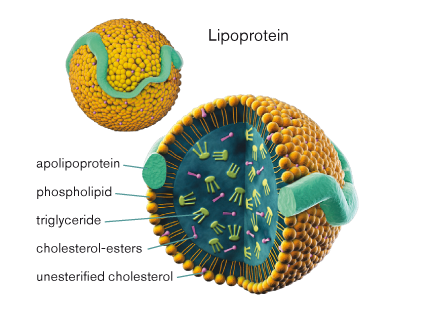
Lipoprotein contains a _____ core surrounded by _____ and _____. Thus, the lipoprotein is able to dissolve lipids in its _____ (hydrophobic or hydrophilic) core and then move freely through the aqueous solution due to its _____ (hydrophobic or hydrophilic) shell.
(Source: https://www.mabtech.com/sites/default/files/apolipoprotein-detail_2.png)
→ Lipid
     Phospholipids
     Apoproteins
     Hydrophobic
     Hydrophilic

Question 41:
Lipoproteins are classified by their density. The greater the ratio of lipid to protein, the _____ (lower or higher) the density.
→ Lower

Question 42:
Because proteins weigh more than an equivalent volume of lipids, the greater the ratio of protein to lipid, the _____ (greater or lesser) the density of that lipoprotein.
→ Greater

Question 43:
Name 4 major classes of lipoproteins.
→ Chylomicrons
     Very low density lipoproteins (VLDL)
     Low density lipoproteins (LDL)
     High density lipoproteins (HDL)

Question 44:
Vitamins are a particular type of _____ (organic or inorganic) molecule that are essential. Being essential means that they _____ (can or cannot) be produced by the body. Vitamin _____ (letter) and vitamin _____ (letter) are examples of fat-soluble vitamins. Fat-soluble vitamins are transported in the body along with _____ (proteins, carbohydrates, fats, or nucleic acids) obtained from the diet, and also _____ (assist or hinder) the absorption of these macromolecules.
→ Organic
     Cannot
     A
     D
     Fats
     Assist

PRACTICE

Question 1:
While the types of lipids are characterized by structures and functional groups, they all share 2 defining characteristics which are _____ and _____.

Question 2:
Are lipids hydrophilic or hydrophobic, polar or non-polar?

Question 3:
Name 4 major roles of lipids and which type plays which role. Also, briefly explain how lipids have these roles.

Question 4:
Name 7 major groups of lipids and give an example for each.

Question 5:
Fatty acids act as fuel for the body via _____ reaction.

Question 6:
Name 3 complex lipids of membrane that have fatty acids as their building blocks.

Question 7:
Fatty acids are composed of _____.

Question 8:
Each fatty acid chain contains an _____ (even or odd) number of carbons.

Question 9:
Name 2 subcategories of fatty acids and briefly describe their components.

Question 10:
High concentration of _____ bonds in fatty acids allows them to store more energy per gram than any other macromolecules in the body.

Question 11:
Most fats reach the cell in the form of _____ which are _____ (components) rather than as _____ which are _____ (components).

Question 12:
Triacylglycerols, phospholipids, and glycolipids are sometimes referred to as _____.

Question 13:
_____ are the building blocks of phospholipids, glycolipids, and sphingolipids.

Question 14:
Triacylglycerols are also known as _____ or _____.

Question 15:
Triacylglycerols are composed of a _____-carbon _____ backbone attached to _____ (number) fatty acid chains. 3 functions of triacylglycerols are _____.

Question 16:
Adipocytes are specialized fat cells whose cytoplasm contains almost nothing but _____.

Question 17:
Phospholipids are lipids attached to a _____ group.

Question 18:
The most important phospholipids are _____.

Question 19:
The simplest phosphoglyceride is _____.

Question 20:
Except phosphatidic acid, all other phosphoglycerides have a phosphatidic acid backbone, which is a _____ backbone attached to a _____ group. This characteristic allows these phosphoglycerides to be referred to ask _____.

Question 21:
Triacylglycerols (AKA _____) are composed of a _____-carbon (number) backbone called _____ attached to _____ (number) fatty acid chains, whereas phosphoglycerides are composed of a _____ backbone attached to _____ (number) fatty acid chains because _____.

Question 22:
In a phosphoglyceride, the phosphate group lies on the _____ (same or opposite) site of the glycerol from the fatty acids, making the phospholipid _____ (polar or non-polar) at the phosphate end and _____ (polar or non-polar) at the fatty acid end.

Question 23:
Molecules that have polar and non-polar ends are referred to as _____.

Question 24:
When forming bilayer membranes, the _____ (polar or non-polar, heads or tails) of phospholipids face toward the watery environment within and outside the cell, while the _____ (polar or non-polar, heads or tails) create an inner layer within the membrane. Generally, the lipid bilayer has _____ (high or low) permeability to polar molecules and _____ (high or low) permeability to non-polar molecules. In other words, the lipid bilayer is _____.

Question 25:
Polar molecules are water-_____ (soluble or insoluble) and fat-_____ (soluble or insoluble), whereas non-polar molecules are fat-_____ (soluble or insoluble) and water-_____ (soluble or insoluble).

Question 26:
Phosphoglycerides are composed of a _____-carbon (number) _____ backbone attached to _____ (number) fatty acid chains because _____, whereas glycolipids are composed of a _____ backbone attached to one or more _____ instead of to the _____.

Question 27:
Both phospholipids and glycolipids have polar ends and non-polar ends, making them _____.

Question 28:
Glycolipids are abundant in membranes of _____ cells in human nervous system.

Question 29:
Phosphoglycerides are composed of a _____ backbone attached to _____ (number) fatty acid chains because _____, whereas sphingolipids are composed of a _____ backbone attached to _____ (number) fatty acid chain.

Question 30:
In a sphingolipid, the sphingosine backbone molecule is an _____.

Question 31:
Phospholipids, glycolipids, steroids, and sphingolipids make up part of the cell's _____.

Question 32:
Steroids are a _____-ringed (number) structure. 4 examples of steroids are _____.

Question 33:
Terpenes are often part of _____ in the body. 1 example of terpenes is _____ which is important for _____.

Question 34:
Waxes are formed by _____ linkage between a long-chain _____ and a long-chain _____. 1 example of waxes  in the human body is _____.

Question 35:
A characteristic texture of waxes is _____.

Question 36:
A minor group of lipids is eicosanoids, which includes _____, _____, and _____.

Question 37:
Eicosanoids are released from cell membranes as local _____ that regulate, among other things, _____, _____, and _____.

Question 38:
_____ is a commonly used inhibitor of prostaglandin synthesis.

Question 39:
Because lipids are _____ (soluble or insoluble) in aqueous solution, they're transported in the blood via _____.

Question 40:
Lipoprotein contains a _____ core surrounded by _____ and _____. Thus, the lipoprotein is able to dissolve lipids in its _____ (hydrophobic or hydrophilic) core and then move freely through the aqueous solution due to its _____ (hydrophobic or hydrophilic) shell.
(Source: https://www.mabtech.com/sites/default/files/apolipoprotein-detail_2.png)

Question 41:
Lipoproteins are classified by their density. The greater the ratio of lipid to protein, the _____ (lower or higher) the density.

Question 42:
Because proteins weigh more than an equivalent volume of lipids, the greater the ratio of protein to lipid, the _____ (greater or lesser) the density of that lipoprotein.

Question 43:
Name 4 major classes of lipoproteins.

Question 44:
Vitamins are a particular type of _____ (organic or inorganic) molecule that are essential. Being essential means that they _____ (can or cannot) be produced by the body. Vitamin _____ (letter) and vitamin _____ (letter) are examples of fat-soluble vitamins. Fat-soluble vitamins are transported in the body along with _____ (proteins, carbohydrates, fats, or nucleic acids) obtained from the diet, and also _____ (assist or hinder) the absorption of these macromolecules.

ANSWER KEY

Question 1:
→ Low solubility in water
     High solubility in non-polar organic solvents

Question 2:
→ Hydrophobic, non-polar

Question 3:
→ Energy storage, thermal insulation, and padding
     Triacylglycerols
     Because lipids have long carbon chains
→ Cellular organization and structure, particularly in membrane
     Phospholipids
     Because lipids are hydrophobic and assemble into barriers separating aqueous environments
→ Provision of precursor molecules for vitamins and hormones
     Some fatty acids (eicosanoids)
     Because lipids can pass through cellular membranes, both of which are hydrophobic
→ Regulation of metabolic activities
     Steroids

Question 4:
→ Fatty acids: omega-3 (found in fish, algae, some plants, and nut oils)
     Triacylglycerols: triglyceride
     Phospholipids: phosphatidylcholine
     Glycolipids: galactocerebroside
     Sphingolipids: sphingosine
     Steroids: cholesterol
     Terpenes: vitamin A1
     Waxes: palmityl palmitate

Question 5:
→ Oxidation

Question 6:
→ Phospholipids
     Glycolipids
     Sphingolipids

Question 7:
→ Long carbon chains truncated at 1 end by a carboxylic acid

Question 8:
→ Even

Question 9:
→ Saturated: only C-C single bonds
     Unsaturated: one or more C=C double bonds

Question 10:
→ C-H

Question 11:
→ Free fatty acids
     Fatty acid chains not attached to a backbone
     Triacylglycerols
     3 fatty acid chains attached to a 3-carbon backbone called glycerol

Question 12:
→ Fatty acids

Question 13:
→ Fatty acids

Question 14:
→ Triglycerides
     Fats and oils

Question 15:
→ 3
     Glycerol
     3
     Energy storage, thermal insulation, and padding

Question 16:
→ Triacylglycerols (AKA triglycerides)

Question 17:
→ Phosphate

Question 18:
→ Phosphoglycerides

Question 19:
→ Phosphatidic acid

Question 20:
→ Glycerol
     Phosphate
     Phosphatids

Question 21:
→ Triglycerides
     3
     Glycerol
     3
     Glycerol
     2
     A polar phosphate group replaces one of the fatty acid chains

Question 22:
→ Opposite
     Polar
     Non-polar

Question 23:
→ Amphipathic

Question 24:
→ Polar heads
     Non-polar tails
     Low
     High
     Semi-permeable

Question 25:
→ Soluble
     Insoluble
     Soluble
     Insoluble

Question 26:
→ 3
     Glycerol
     2
     A polar phosphate group replaces 1 of the fatty acid chains
     Glycerol
     Carbohydrates
     Phosphate group

Question 27:
→ Amphipathic

Question 28:
→ Myelinated

Question 29:
→ Glycerol
     2
     A polar phosphate group replaces 1 of the fatty acid chains
     Sphingosine
     1

Question 30:
→ Amino alcohol

Question 31:
→ Membrane

Question 32:
→ 4
     Membrane component, hormones, vitamin D, and cholesterol

Question 33:
→ Pigments
     Vitamin A
     Vision

Question 34:
→ Ester
     Alcohol
     Fatty acid
     Ear wax

Question 35:
→ Water-repellence

Question 36:
→ Prostaglandins
     Thromboxanes
     Leukotrienes

Question 37:
→ Hormones
     Blood pressure
     Body temperature
     Smooth muscle contraction

Question 38:
→ Aspirin

Question 39:
→ Insoluble
     Lipoproteins

Question 40:
→ Lipid
     Phospholipids
     Apoproteins
     Hydrophobic
     Hydrophilic

Question 41:
→ Lower

Question 42:
→ Greater

Question 43:
→ Chylomicrons
     Very low density lipoproteins (VLDL)
     Low density lipoproteins (LDL)
     High density lipoproteins (HDL)

Question 44:
→ Organic
     Cannot
     A
     D
     Fats
     Assist

Saturday, December 10, 2016

MCAT · Biology 1 · Chapter 1 · Section 1.2

Chapter 1: Biological Molecules and Enzymes

Section 1.2: Water

STUDY

Question 1:
Name 3 roles of water in chemical reactions of living cells.
→ Solvent, reactant, product

Question 2:
What property of water makes it a perfect solvent for chemical reactions in the body?
→ Polarity

Question 3:
Due to polarity and H-bonding, water is allow to:
→ Pull apart polar molecules or ions and form ordered networks around them
     Force non-polar molecules to congregate (= aggregate = agglutinate) together

Question 4:
What percent of cell's mass does water take up?
→ 70 to 80 percent

Question 5:
What differentiates water from most other compounds that are just as light as water, in regards to their states at typical cell temperatures (= in cellular environment)?
→ Water remains in liquid state, while others exist as gas.

Question 6:
How does water remain in liquid state in cellular environment?
→ H-bonding between water molecules, which elevates boiling point

Question 7:
How does water "squeeze" hydrophobic molecules away and cause these molecules to aggregate?
→ Strong cohesive forces between water molecules, which are provided by H-bonding

Question 8:
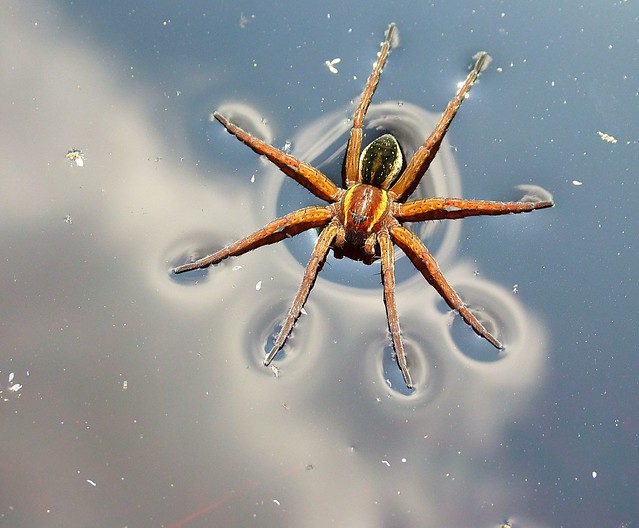
What allows water to support the raft spider (a species that can walk on water without sinking)?

(Source: https://c1.staticflickr.com/1/82/237875014_4d579d57c5_z.jpg?zz=1)

→ Cohesive forces created by H-bonding between water molecules 

Question 9:
How do hydrophilic molecules or ionic compounds dissolve easily in water?
→ Molecules' or compounds' (-) charged ends are attracted to partial positive charge (δ+) of
     water's Hydrogens, while (+) charged ends are attracted to partial negative charge (δ-) of
     water's Oxygen.

Question 10:
Water surrounds a hydrophilic molecule or ion. Which one is solvent and which one is solvate?
→ Solvent: water
     Solvate: hydrophilic molecule or ion

Question 11:
In living cells, what reaction and what process break macromolecules apart? Briefly explain the reaction.
→ Reaction: hydrolysis, breaking macromolecule into 2 smaller molecules by adding H and OH of
     water to either end
     Process: digestion

Question 12:
Hydrolysis of which molecule provides the body's major source of energy?
→ ATP

Question 13:
In living cells, mostly what reaction forms macromolecules? Briefly explain the reaction. What's the byproduct?
→ Reaction: dehydration, when 2 molecules are combined to form a larger molecule
     Byproduct: water

Question 14:
Dehydration is the reverse reaction of what reaction?
→ Hydrolysis

Question 15:
Between hydrolysis and dehydration: Which forms bonds and which breaks bonds? Which gains water and which loses water?
→ Hydrolysis breaks and gains. Dehydration forms and losses.

Question 16:
Dehydration allows formation of _____ bonds that make up proteins and _____ bonds that make up triglycerides.
→ Proteins: peptide bonds
     Triglycerides: ester bonds

PRACTICE

Question 1:
Name 3 roles of water in chemical reactions of living cells.

Question 2:
What property of water makes it a perfect solvent for chemical reactions in the body?

Question 3:
Due to polarity and H-bonding, water is allow to:

Question 4:
What percent of cell's mass does water take up?

Question 5:
What differentiates water from most other compounds that are just as light as water, in regards to their states at typical cell temperatures (= in cellular environment)?

Question 6:
How does water remain in liquid state in cellular environment?

Question 7:
How does water "squeeze" hydrophobic molecules away and cause these molecules to aggregate?

Question 8:
What allows water to support the raft spider (a species that can walk on water without sinking)?

(Source: https://c1.staticflickr.com/1/82/237875014_4d579d57c5_z.jpg?zz=1)

Question 9:
How do hydrophilic molecules or ionic compounds dissolve easily in water?

Question 10:
Water surrounds a hydrophilic molecule or ion. Which one is solvent and which one is solvate?

Question 11:
In living cells, what reaction and what process break macromolecules apart? Briefly explain the reaction.

Question 12:
Hydrolysis of which molecule provides the body's major source of energy?

Question 13:
In living cells, mostly what reaction forms macromolecules? Briefly explain the reaction. What's the byproduct?

Question 14:
Dehydration is the reverse reaction of what reaction?

Question 15:
Between hydrolysis and dehydration: Which forms bonds and which breaks bonds? Which gains water and which loses water?

Question 16:
Dehydration allows formation of _____ bonds that make up proteins and _____ bonds that make up triglycerides.

ANSWER KEY

Question 1:
→ Solvent, reactant, product

Question 2:
→ Polarity

Question 3:
→ Pull apart polar molecules or ions and form ordered networks around them
     Force non-polar molecules to congregate (= aggregate = agglutinate) together

Question 4:
→ 70 to 80 percent

Question 5:
→ Water remains in liquid state, while others exist as gas.

Question 6:
→ H-bonding between water molecules, which elevates boiling point

Question 7:
→ Strong cohesive forces between water molecules, which are provided by H-bonding

Question 8:
→ Cohesive forces created by H-bonding between water molecules

Question 9:
→ Molecules' or compounds' (-) charged ends are attracted to partial positive charge (δ+) of
     water's Hydrogens, while (+) charged ends are attracted to partial negative charge (δ-) of
     water's Oxygen.

Question 10:
→ Solvent: water
     Solvate: hydrophilic molecule or ion

Question 11:
→ Reaction: hydrolysis, breaking macromolecule into 2 smaller molecules by adding H and OH of
     water to either end
     Process: digestion

Question 12:
→ ATP

Question 13:
→ Reaction: dehydration, when 2 molecules are combined to form a larger molecule
     Byproduct: water

Question 14:
→ Hydrolysis

Question 15:
→ Hydrolysis breaks and gains. Dehydration forms and losses.

Question 16:
→ Proteins: peptide bonds
     Triglycerides: ester bonds

MCAT · Biology 1 · Chapter 1 · Section 1.1

Chapter 1: Biological Molecules and Enzymes

Section 1.1: Introduction

STUDY 

Question 1:
Name 4 classifications of most biological molecules, give an example for each, and name a similarity between them all.
→ Lipids: phospholidpid
     Proteins: collagen
     Carbohydrates: amylose
     Nucleotide derivatives: ATP (= Adenosine TriPhosphate)
→ Similarity: carbon skeleton

Question 2:
In living organisms, biological molecule's personality is _____ and it matches _____.
→ Structure and polarity
     Practical usage

Question 3:
Enzyme-substrate fit correlates with _____ and _____.
→ Enzyme effectiveness
     Lower Km

Question 4:
Competitive inhibitors bind to _____ (location) and _____ (action).
→ Active site
     Block it

Question 5:
Non-competitive inhibitors bind to _____ (location) and _____ (action).
→ Separate site
     Change shape of active site

Question 6:
Un-competitive inhibitors bind to _____ (location) and _____ (action).
→ Enzyme-substrate complex
     Decrease concentration of substrate that can react

PRACTICE

Question 1:
Name 4 classifications of most biological molecules, give an example for each, and name a similarity between them all.

Question 2:
In living organisms, biological molecule's personality is _____ and it matches _____.

Question 3:
Enzyme-substrate fit correlates with _____ and _____.

Question 4:
Competitive inhibitors bind to _____ (location) and _____ (action).

Question 5:
Non-competitive inhibitors bind to _____ (location) and _____ (action).

Question 6:
Un-competitive inhibitors bind to _____ (location) and _____ (action).

ANSWER KEY

Question 1:
→ Lipids: phospholidpid
     Proteins: collagen
     Carbohydrates: amylose
     Nucleotide derivatives: ATP (= Adenosine TriPhosphate)
→ Similarity: carbon skeleton

Question 2:
→ Structure and polarity
     Practical usage

Question 3:
→ Enzyme effectiveness
     Lower Km

Question 4:
→ Active site
     Block it

Question 5:
→ Separate site
     Change shape of active site

Question 6:
→ Enzyme-substrate complex
     Decrease concentration of substrate that can react

Sunday, December 4, 2016

General Mechanism of Photosynthesis


01. Light hits thylakoid membrane.

02. Light energy is absorbed by accessory chlorophyll pigment in light-harvesting complex LH2.

03. Excitation energy passes from pigment to pigment (resonance energy transfer).

04. Excitation energy passes to PRC in LH1's center.
      - PRC: photosynthetic reaction center, where electron transfer reaction occurs,
      similar to electron transport chain in mitochondria.

05. Light energy is absorbed by special pair of chlorophyll.

06. Electron is excited from special pair of chlorophyll A → accessory chlorophyll A
      → pheophytin A → quinone A → quinone B → ultimately out of reaction center.

07. Final electron acceptor: NADP+ → NADPH (reduced).

08. Electron movement creates electrochemical gradient across thylakoid membrane.

09. H+ is pumped from stroma into lumen.

10. H+ flows out of cell to drive ATP synthesis.

11. Cytochrome heme group is oxydized to replace electron loss in special pair of chlorophyll.

12. H20 hydrolysis provides electron to replenish cytochrome and the overall system.

Saturday, September 24, 2016

Dear My Blog's Student Visitors

I never thought my blog would be so often visited because of my MasteringBio contents. Thank you for utilizing them and for expressing your gratitude. It brought my heart so much joy when you shared with me that they're helpful and that you're thankful. It's the most that I could ever ask for: to aid you in studying for your bio classes. In other words, I hope you would utilize my blog's contents as a tool for success, not a shortcut.

As I progress in my journey toward medicine, starting off as a K-12 student dreaming of caring for others to currently being a premed majored in bio, I realize more and more the importance of knowing the materials by heart instead of trying to get an A and not really knowing the materials.

I would like to share with you an image that I found a long time ago but still, to this day, find it motivational. It's an image that I look at when I feel lost in my seemingly forever journey toward medicine. It's an image that I look at when I doubt myself and my abilities. It's also an image that I look at when I ask myself why I'm driven.


And my answer has always been: for the people.

I'm telling you all these because I have my hope for you. You have ups and downs, but I hope you don't always frown. Because you're potential and incredible. Yes, you! You're the one that can make a difference in many. However...

I hope you're pursuing medicine because you would put the people first – instead of fame, money, status, or yourself. I hope you're pursuing medicine because you would like to make the people feel better – instead of making yourself look better. Last but not least, I hope you're pursuing medicine because it's your dream – instead of others' dream for you.

I wish you the best in your journey, not just toward medicine but toward anything that you dream to pursue. Go big or go bigger, then go home knowing that out there you just made a difference!